Does a hysterectomy really cause rapid aging?
While the concept of rapid aging after the surgical procedure of hysterectomy is not entirely a myth, we often misunderstand it on many levels. Hysterectomy by itself, without removal of the ovaries, does not cause any direct effects of aging. However, with the removal of the ovaries, the body experiences an abrupt drop in estrogen, which in turn may cause some effects of aging.
Estrogen is one of the most important hormones when it comes to our endocrine system. It is mainly responsible for the development and regulation of the female reproductive system as well as secondary sexual characteristics. It takes charge of skin elasticity, bone density, heart health, as well as executive and cognitive function. After a surgical procedure like a hysterectomy, estrogen levels drop abruptly, which can show signs commonly associated with aging much earlier than expected.
How do hormones play a huge role in aging?
Estrogen is often referred to as the “youth hormone”, and now we know why. When estrogen levels drop after a hysterectomy, it can have a noticeable impact on your overall health and bodily regulation. While the ovaries are responsible for secreting most of the estrogen in your body, the adrenal gland and adipose tissue also contribute to the secretion. Estrogen receptors are located throughout the body, travelling through the blood and stimulating the part of your body that needs to come into action.
After a hysterectomy, when the ovaries are removed, major estrogen secretion comes to a halt. As a result, it affects many areas of the body. It has a direct impact on your cholesterol levels, blood sugar levels, bone density, and muscle mass. Other than that, a lack of estrogen production can also affect your cardiovascular health, collagen production in your skin, and decrease your focus and attention span, affecting your cognitive function.
Common signs that may feel like rapid aging
While estrogen levels do determine a lot that goes on in your body, there can be some particular signs that show up after a hysterectomy in some women that indicate aging factors. Some of these bodily shifts can be:
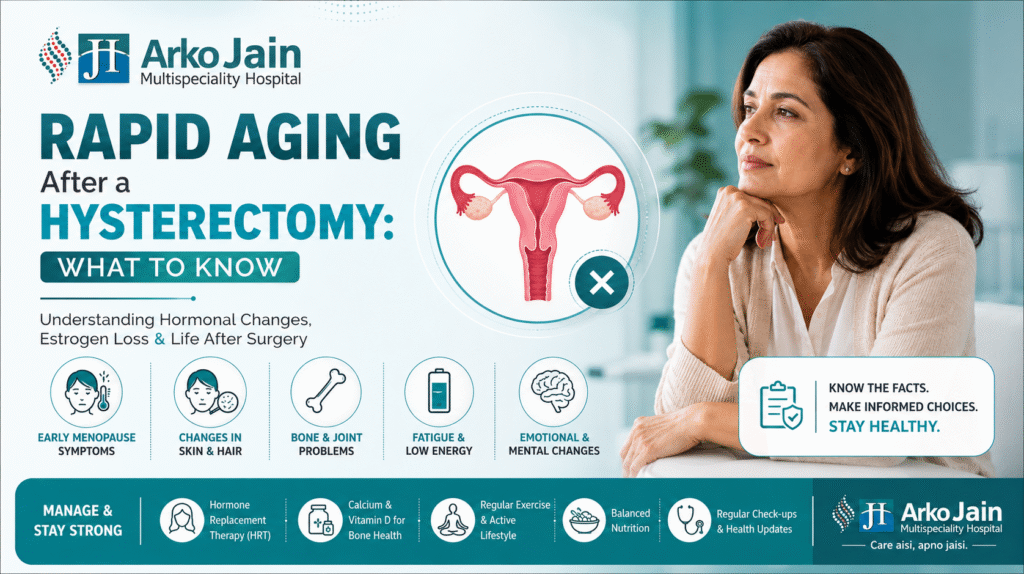
1. Early menopause symptoms: When the ovaries are removed during a hysterectomy, menopause is said to occur immediately. This sudden change in hormones may cause hot flashes, night sweats, mood swings, and sleep problems. Such symptoms may be more severe than in women who go through menopause naturally.
2. Changes in skin and hair: Estrogen is also responsible for maintaining firmness in both the skin and hair. When estrogen levels drop in women who have undergone a hysterectomy with the removal of the ovaries, their skin may become drier and less firm, causing them to lose more hair than they would at other times in their lives.
3. Bones and joints problems: Estrogen levels also affect bone density. When estrogen levels drop, women may be more likely to develop osteoporosis. Some women may also experience joint pain or stiffness, as estrogen is responsible for maintaining strong bones.
4. Fatigue and low energy: The hormonal changes that occur during the postoperative period following a hysterectomy affect energy levels. A woman may feel more tired than normal or notice that she is not as energetic or vibrant. This affects her productivity in that she may have to make significant lifestyle changes to cope with low energy levels.
5. Emotional and mental fluctuations: Hysterectomy also affects emotional stability. Some women may notice that they have mood swings or that their minds do not work as well as they used to. However, it is essential to understand that all women do not respond in the same way.
How can these effects be managed?
Despite the numerous changes a hysterectomy may bring to you, modern medicine’s advent brings solutions in greater numbers. The changes after a hysterectomy are bound to show up in the way they do, but with the help of medicinal treatment as well as a few lifestyle changes, one can successfully turn this around. Some of these shifts are: